Rajkot Engineering Industry Maintains Strong Manufacturing Identity
 📅 September 19, 2026
⏱ 6 min read
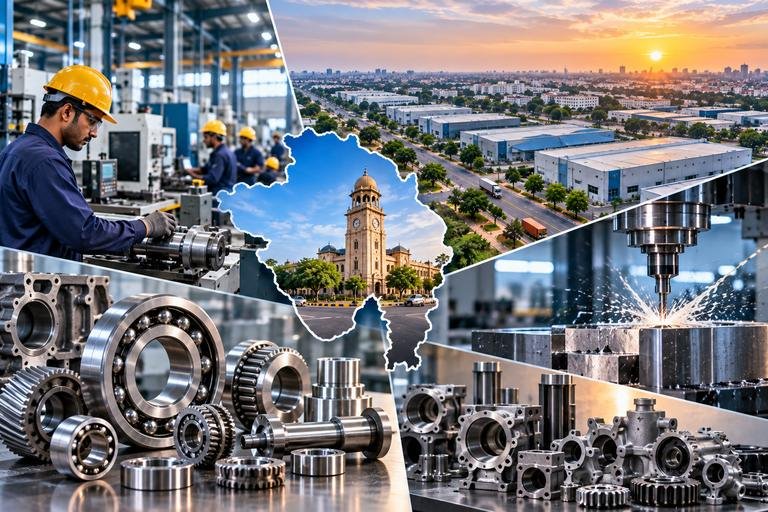
Rajkot, Gujarat: Rajkot continues to maintain a strong identity as one of Gujarat’s important engineering and manufacturing centres, supported by a broad network of small and medium-sized industrial enterprises. The city’s industrial ecosystem has developed across multiple interconnected segments, including auto components, machine tools, foundry products, forging, bearings, pumps, diesel engines and other precision engineering products. Government and cluster-level studies have consistently identified engineering and auto-ancillary manufacturing as major components of Rajkot’s industrial base.
Diverse Engineering Manufacturing Base
Rajkot’s engineering industry is not concentrated in a single product category. Instead, the region has developed a connected manufacturing ecosystem in which foundries, forging units, machining companies, component manufacturers and machine-tool producers support one another.
The Government of India’s Rajkot District Export Promotion Plan identifies engineering products such as bearings, diesel engines, automotive parts, forgings, castings, machine tools and CNC machines among the key products associated with the district. Industrial concentrations extend across areas including Aji Vasahat, Gondal Road, Bhavnagar Road, Shapar-Veraval and Metoda.

This diversity gives manufacturers access to a relatively broad local supply chain, from metal processing and casting to machining, component manufacturing and assembly.
Machine Tools and CNC Manufacturing
Machine-tool manufacturing remains an important part of Rajkot’s engineering identity. A cluster study identifies roughly 400 machine-tool and allied manufacturing units across industrial areas such as Shapar, Aji, Bamanbore, Kothariya, Samrat, Atika and Metoda.
The sector includes conventional lathes and presses as well as more advanced equipment such as CNC machines, vertical machining centres and horizontal machining centres. Some manufacturers have also developed customized machines for specific industrial applications.
The growth of CNC and precision machining capabilities is significant because these technologies allow manufacturers to produce components with tighter dimensional control and greater production consistency.
Foundry and Casting Ecosystem
Foundry manufacturing forms another major pillar of Rajkot’s engineering economy. The district’s industrial studies describe a substantial foundry cluster that historically developed to serve the requirements of the local diesel-engine industry and subsequently expanded into wider engineering and automotive supply chains.
Castings produced within the region support applications ranging from industrial machinery and electric motors to automotive components and machine tools. The geographical spread of foundry activity across several industrial estates has also helped create close connections between casting suppliers and downstream manufacturers.
These linkages are important for Rajkot’s engineering ecosystem because cast components can move from foundries to machining and component-manufacturing units within the broader regional industrial network.
Forging and Auto Components
Forging is another established segment within Rajkot’s manufacturing landscape. Industry-cluster information describes a significant concentration of MSME forging units producing precision components for automobiles, compressors, earth-moving machinery, electrical equipment and machine tools.
Rajkot also has a sizeable auto-component manufacturing base. A cluster study covering the sector identifies manufacturers producing components such as crankshafts, connecting rods, kingpins, tappet valves, cylinder liners, differential cases, gear-shifter shafts, rocker arms, camshafts, valve guides, pistons and rings.
The relationship between these sectors is particularly important. Forging and foundry units can supply semi-finished components, while machining companies perform additional processing and finishing before components reach vehicle and equipment manufacturers.
Bearings and Precision Engineering
Bearings represent another well-established engineering product associated with Rajkot. The district’s export-planning documentation lists bearings among the region’s engineering products and highlights the wider presence of engineering and auto-ancillary industries.
The bearing segment also connects naturally with Rajkot’s machine-tool, automotive, industrial-equipment and machining ecosystem. Demand from these sectors creates opportunities for manufacturers specializing in precision components, turning, grinding and related manufacturing processes.
MSMEs Form the Backbone
A defining characteristic of Rajkot’s industrial structure is the strong presence of micro, small and medium enterprises. Cluster research has estimated around 15,000 MSME units across Rajkot, with a large proportion associated with foundry and engineering activities.
This MSME network enables specialization. Rather than every manufacturer carrying out every stage of production internally, different companies can focus on casting, forging, machining, tooling, heat treatment, surface finishing, component production or assembly.
Such specialization can create a flexible industrial supply chain and allow smaller companies to participate in larger manufacturing programs.
Industrial Areas Supporting the Ecosystem
Rajkot’s engineering activities are distributed across multiple industrial locations rather than being limited to one manufacturing zone. Shapar-Veraval, Metoda, Aji, Gondal Road, Bhavnagar Road and other industrial areas have developed as important locations for engineering and manufacturing enterprises.
The concentration of complementary businesses in these areas can reduce supply-chain distances and make it easier for manufacturers to source components, services, tooling and industrial support locally.
From Traditional Manufacturing to Modern Engineering
Rajkot’s industrial development demonstrates a gradual transition from traditional workshops and basic manufacturing toward more sophisticated engineering capabilities.
The Rajkot Chamber of Commerce and Industry describes the historical growth of engineering in the city, including the development of machinery and machine-tool manufacturing from the early industrial period.
Today, the ecosystem includes CNC and VMC equipment, precision machining, specialized tooling and increasingly technology-driven production processes. This evolution allows traditional manufacturing companies to participate in more demanding supply chains while retaining the flexibility associated with the region’s MSME structure.
Opportunities for Further Industrial Development
Rajkot’s established supplier network provides a foundation for further development in precision engineering, industrial automation, automotive components, machinery, renewable-energy equipment and other manufacturing segments.
Future competitiveness will depend on factors such as technology adoption, product quality, skilled manpower, energy efficiency, automation, testing facilities and the ability of MSMEs to meet increasingly demanding domestic and international standards.
The combination of established industrial knowledge and a dense supplier ecosystem gives Rajkot a significant manufacturing foundation from which individual companies can expand into higher-value engineering products.
Outlook
Rajkot’s engineering industry remains closely connected to the city’s broader manufacturing identity. Its combination of foundries, forging companies, machine-tool manufacturers, auto-component producers, bearing manufacturers and other engineering MSMEs creates an integrated industrial ecosystem rather than a collection of isolated businesses.
As manufacturing requirements increasingly move toward precision, automation and higher-value components, Rajkot’s existing industrial capabilities provide a platform for companies to modernize production and develop new markets.
The city’s engineering story is therefore not only About its traditional manufacturing base but also about how that base continues to evolve through technology, specialization and stronger integration with wider industrial supply chains.